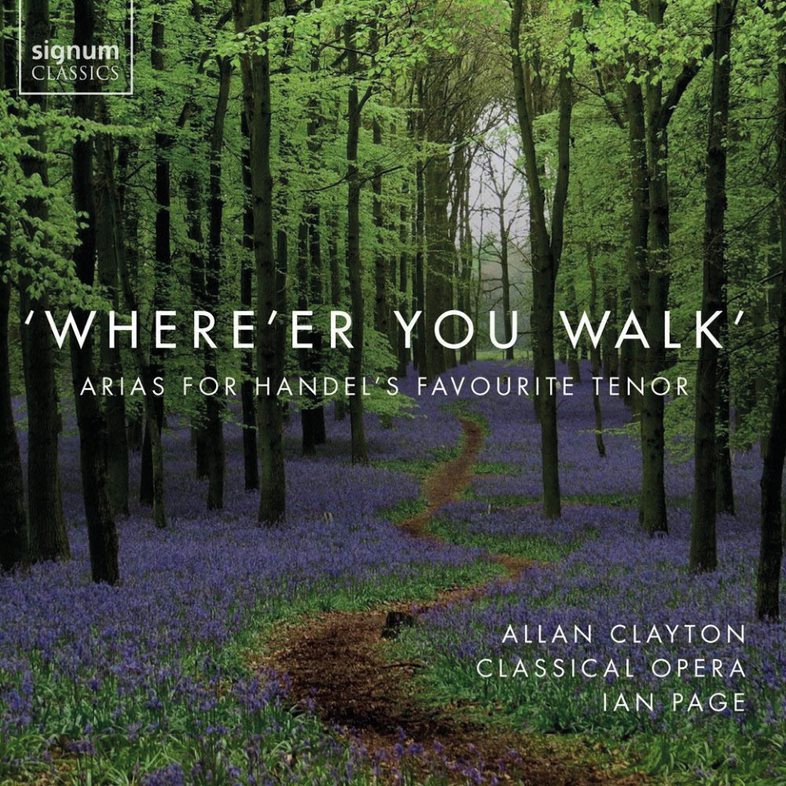
Where’er you walk
£12.00
EARLY MUSIC REVIEW
John Beard’s career on the London stage
John Beard (c.1715-1791) is commonly described as Handel’s longest-serving singer, and this description is paradoxically both fair and misleading. The English tenor sang a plethora of roles in Handel’s performances of theatre works on an almost annual basis for a quarter-century, the repertoire comprising Italian operas and unstaged English works such as oratorios (both dramatic and not-so-dramatic), odes, classical dramas and other less conveniently classifiable entertainments. However, the present collection of music associated with Beard attempts to reveal a more nuanced portrait of his long and varied career on the London stage.
The biographer Neil Jenkins conjectures reasonably that Beard was probably seventy-five years old when he died on 5 February 1791, so it is possible that he was the infant christened at St Botolph, Bishopsgate on 6 October 1715. It is likely that he was among the first new boy choristers to be admitted to the choir of the Chapel Royal after the appointment of Bernard Gates as the Master of the Children in 1727. It is possible that the twelve-year-old Beard might have taken part in the coronation service of King George II and Queen Caroline at Westminster Abbey on 11 October 1727, and it is likely that the boy treble would have sung Handel’s four coronation anthems at a private concert performance held three years later at Gates’ own house in James Street, Westminster. On 23 February 1732 Gates organised a performance of Handel’s old Cannons oratorio Esther by choristers from the Chapel Royal and Westminster Abbey, and instrumentalists from the Philharmonic Society. The performance celebrating Handel’s 47th birthday might have taken place at Gates’ house, but two subsequent performances took place in the concert room at the Crown and Anchor tavern on the Strand. The libretto printed for these performances credits Beard in the part of ‘Priest Israelite’, but it is unclear what music this involved. In any case, Gates’ performances of Esther were crucially significant in two respects: firstly, they probably brought the chorister Beard to Handel’s attention as a capable soloist; secondly, they set off a rapid chain of events that led to the composer unveiling his own considerably expanded and rewritten version at the King’s Theatre on 2 May 1732 – not only Handel’s first public performance of an oratorio in London but also featuring his Italian opera singers alongside choral reinforcements provided by Gates (possibly including the sixteen-year-old Beard).
On 29 October 1734 Beard was officially granted an honourable discharge from his service at the Chapel Royal, although it seems that his voice had actually broken at least six months earlier. Within a fortnight he made his début for Handel’s opera company as the avid hunter Silvio in an expanded revival of Il pastor fido on 9 November. Just before the end of its run of five performances, Lady Elizabeth Compton wrote to the Countess of Northampton:
A Scholar of Mr Gates, Beard, (who left the Chappel last Easter) shines in the Opera of Covent Garden & Mr Hendell is so full of his Praises that he says he will surprise the Town with his performances before the Winter is over.
Handel had just relocated his projects to John Rich’s new theatre at Covent Garden (which had opened in 1732), paying the owner of the theatre rent and house charges for using the theatre two nights each week during the opera season. Moreover, all of the operas performed at Covent Garden during the 1734-35 season featured a French ballet troupe led by Marie Sallé, and leading Italian singers (Carestini and Strada) sang alongside home-grown English talent – not only the new tenor Beard but also the gifted soprano Cecilia Young (the future Mrs Arne). It was for this company that Handel created two new elaborate operas, Ariodante and Alcina, both of which included important roles for the young tenor.
For the next two seasons Beard continued to perform in Handel’s opera seasons at Covent Garden, but a landmark event was his participation in the first performance of Alexander’s Feast on 19 February 1736. Handel’s adaptation of Dryden’s literary ode not only placed Beard’s tenor solos fully at the forefront of the dramatic narrative for the first time in any of his works, but also its critical and popular success sparked a sequence of English-language concert works that exploited the rich seam of the greatest seventeenth-century English poetry: Beard’s talents were fully exploited in Handel’s setting of Dryden’s From harmony, heav’nly harmony (designed as an afterpiece to a revival of Alexander’s Feast at Lincoln’s Inn Fields on Saint Cecilia’s Day in 1739), and later on in the same season he was a central part of Handel’s inspired response to poems by Milton in the ambitious musico-literary masterpiece L’Allegro, il Penseroso ed il Moderato, in which Beard’s tenor personification of Mirth argues with the soprano Melancholy until, in the final part of the ode, they are reconciled by enlightened reason in the sublime duet “As steals the morn”. The successful intersection of Milton, Handel and Beard reached its zenith in an adaptation of the closet drama Samson Agonistes (1671), adapted for Handel by Newburgh Hamilton and first performed at Covent Garden in 1743.
In the meantime Beard’s newfound fame as one of London’s leading singers accelerated to unwelcome notoriety. Reputedly a charming, handsome and sociable man, a scandal erupted when he married Lady Henrietta Waldegrave in a secret ceremony at Fleet Prison on the afternoon of 8 January 1739 – in between a rehearsal for Handel’s new oratorio Saul in the morning and a performance as ‘The Spaniard’ in the pantomime Colombine Courtesan at Drury Lane that evening! Whilst liaisons of dubious honour between peers of the realm and theatre actresses were common enough, this turned the tables by being the first marriage between a British noblewoman and a lowly singer-actor. The bride was the daughter of the 1st Earl Waldegrave, a member of Walpole’s government and the British ambassador to Paris (and the illegitimate grandson of the exiled catholic James II), but to complicate matters irrevocably Henrietta was also the widow of Lord Edward Herbert (the second son of the Marquis of Powis), whose premature death in 1734 after only four months of marriage left his eighteen-year-old widow already pregnant with a daughter. The marriage between Beard and Lady Henrietta seems to have been happy but it caused her to be disowned by the offended Waldegraves and scorned by the selfish Herberts, who prevented her from receiving the legally-promised jointure from her late husband’s estate. Many years of unpleasant legal wrangling ended bitterly when Henrietta died in 1753, reportedly distraught after her fifteen-year-old daughter Barbara was forcibly married to the new Marquis of Powis (aged 48) and all contact was severed – thereby keeping the money in the Herbert family and away from Henrietta.
There was also a fair share of political topsy-turvy in John Beard’s contractual involvements with London’s different theatres. In August 1737 he began acting at Drury Lane, where he delivered his first spoken dialogue in the play The Devil to Pay. Thereafter he had a long association with plays (often singing interval songs or afterpieces), and also performed in pantomimes, burlesques and ballad operas; he was a renowned interpreter of the scoundrel Macheath in revivals of John Gay’s The Beggar’s Opera, but he also still had plenty of involvement in more ‘serious’ musical genres such as operas, odes and oratorios. In 1743 he was part of a rebellion by twelve principal performers against the inept Drury Lane manager Charles Fleetwood, and so the following September he returned to John Rich’s theatre at Covent Garden (and on Christmas Eve he was elected a member of the Sublime Society of Beefsteaks – a selective club of fun-loving theatrical friends established by Rich, the scenery painter George Lambert and William Hogarth in 1735). However, in 1748 Beard signed a three-year contract to return to Drury Lane under the new management of the celebrated actor David Garrick, and it may not be coincidental that during the 1748-50 seasons he did not sing in Handel’s Lenten oratorio concerts (the composer instead recruiting the tenor Thomas Lowe).
In addition to his contractual theatre work, Beard sang regularly at London’s Pleasure Gardens at Vauxhall, Marylebone and at Ranelagh in Chelsea (where often during the summer months he sang in breakfast concerts at the cavernous Rotunda several times a week). In addition to performing at music festivals outside London, such as the Three Choirs meetings, Salisbury, Cambridge and Oxford, he also sang often at the Chapel Royal, in court odes, in benefit concerts for colleagues and in charity fundraisers; in 1738 he was a founder member of the Fund for the Support of Decay’d Musicians and he participated regularly in its annual fundraising concerts (the organisation evolved into the Royal Society of Musicians when George III granted it a charter in 1790). From 1751 Beard appeared in Handel’s annual performances of Messiah at the chapel of the Foundling Hospital, and he was elected as one the orphanage’s governors in 1760; his portrait now hangs in the Foundling Museum.
Beard’s busy diary as a theatre performer and concert singer included numerous engagements with other leading British composers of the mid-eighteenth century. He sang in many odes by William Boyce (1711-1779), and both John and Henrietta Beard are listed among the 268 subscribers of the score of the serenata Solomon printed in 1743; its first performance might have been given by the Apollo Academy at London’s Devil Tavern in autumn 1742 (most likely under the direction of Maurice Greene), and there is no evidence that Beard took part, although he certainly sang the tenor solos in subsequent revivals under Boyce’s direction. Beard also collaborated closely with Handel’s pupil, assistant and eventual successor John Christopher Smith junior (1712-1795) in the English comic opera The Fairies – a production by Garrick based on A Midsummer Night’s Dream that was first performed at Drury Lane in 1755. Beard also worked for Thomas Augustine Arne (1710-1778), singing the tenor solo verses in ‘Rule Britannia!’ as the title-hero in the patriotic masque Alfred (first performed for the Prince of Wales at Cliveden in 1740 and later extended into a quasi-operatic entertainment for the London stage), and towards the end of Beard’s long career he played the role of the treacherous villain Artabanes in Arne’s opera Artaxerxes, an old serious drama by the Italian poet Metastasio that was adapted into English and first performed at Covent Garden in 1762.
It was hardly coincidental that Arne’s attempt at an English counterpart of an Italian-style opera seria was mounted at Covent Garden. By this time Beard was much more than just a performer at the theatre in which he had made his stage début twenty-eight years earlier. In 1759 he had married Charlotte Lane, the widowed daughter of Covent Garden’s founder and owner John Rich, and Beard soon assisted his old friend and father-in-law in the day-to-day running of the theatre. Upon Rich’s death in 1761 he managed the theatre on behalf of the family and, as well as hosting the first production of Artaxerxes, Beard was also responsible for enabling Handel’s successors J. C. Smith and John Stanley to try their hand at composing their own new oratorios in addition to organising their Lenten revivals of old Handelian favourites (all of which featured Beard singing principal parts). Not everything went smoothly for the new manager – an attempt to abolish the traditional rule that latecomers were allowed free admission to the final act caused a destructive riot during a revival of Artaxerxes on 24 February 1763, and the onset of deafness caused him to retire from public performance in 1767. Beard sold Covent Garden’s patent for £60,000 and divided the proceeds equally between the five surviving members of the Rich family, and he was also guaranteed an annual royal pension of £100 because of his distinguished court appointment as ‘Vocal Performer in Extraordinary’ (granted to him in 1764 by George III, who had attended the tenor’s performances frequently since the age of six). The singer’s last documented performance was in Boyce’s ode Let the voice of music breathe, performed on New Year’s Day 1768 for George III.
The foremost English tenor of his age retired to Hampton, Middlesex, building a villa that he called ‘Rose Hill’ on several acres of land acquired from near-neighbour and old colleague Garrick (nowadays the house is Hampton’s public library). At around the time of his 70th birthday a group of former Chapel Royal choristers invited the septuagenarian Beard to attend a special dinner on 21 October 1785 that celebrated the centenary of the birth of Bernard Gates. Moreover, in 1787 Beard was among the nearly 400 subscribers to support Samuel Arnold’s endeavour to publish the first complete edition of Handel’s works. After his death on 5 February 1791 he was buried in Hampton’s Parish church of St. Mary the Virgin, where a monument was installed in the north aisle that features a quotation from the opening vocal part of “When thou tookest upon Thee to deliver man” from Handel’s Dettingen Te Deum (actually written for the Chapel Royal bass John Abbot). However, the most fitting eulogies for John Beard are remarks by his contemporaries. The eighteenth-century historian Charles Burney claimed that Beard “constantly possessed the favour of the public by his superior conduct, knowledge of Music, and intelligence as an actor”. Charles Dibdin was given his first big opportunity as a theatre composer by Beard in 1764, and many years later praised his mentor effusively in his chapter discussing singers in the five-volume A Complete History of the English Stage (1797):
BEARD was a singer of great excellence. His voice was sound, male, powerful, and extensive. His tones were natural and he had flexibility enough to execute any passages however difficult, which task indeed frequently fell to his lot in some of HANDEL’s oratorios. … … He was one of those you might fairly try by SHAKESPEAR’s speech to the actors. He did not mouth it, but his words came trippingly over the tongue; … he begot a temperance that gave his exertions smoothness; he never outstepped the modesty of nature, nor made the judicious grieve; in short he never did more than was set down for him, he never set on a quantity of barren spectators to applaud while some necessary question of the song stood still; he let his own discretion be the tutor, and held the mirror up to nature. Well might one apostrophize in imitation of Hamlet. Oh there be singers that I have listened to, and heard others applaud, aye, and encore too, that neither having the accent of Eunuch, man, or beast, yet a mixture of all three, or possessing a single trait of fancy, taste, or expression, have so soared, so sunk, and so cantabileed, that one would have thought some Ventriloquist had made singers, and not made them well, they imitated braying so abominably. BEARD was the reverse of this: besides, he was very valuable as an actor.
David Vickers
| 1 | HANDEL: Air, “Tune your harps to cheerful strains” from Esther | 3’47 |
| 2 | HANDEL: Aria, “Sol nel mezzo risona del core” from Il pastor fido | 3’51 |
| 3 | HANDEL: Sinfonia to Act 2 from Ariodante | 1’06 |
| 4 | HANDEL: Aria, “Tu vivi, e punito” from Ariodante | 3’38 |
| 5 | HANDEL: Recitativo, “M’inganna, me n’avveggo” from Alcina | 0’16 |
| 6 | HANDEL: Aria, “Un momento di contento” from Alcina | 4’09 |
| 7 | HANDEL: Air, “Happy pair” from Alexander’s Feast | 2’11 |
| 8 | HANDEL: Chorus, “Happy pair” from Alexander’s Feast | 2’19 |
| 9 | HANDEL: Aria, “Vedi l’ape che ingegnosa” from Berenice | 4’35 |
| 10 | HANDEL: Duet, “As steals the morn” from L’Allegro, il Penseroso ed il Moderato [with Mary Bevan (soprano)] | 5’50 |
| 11 | BOYCE: Sinfonia to Part 2 from Solomon | 2’32 |
| 12 | BOYCE: Recitative, “My fair’s a garden of delight” from Solomon | 0’22 |
| 13 | BOYCE: Air, “Softly rise, o southern breeze” from Solomon | 3’20 |
| 14 | BOYCE: Chorus, “Ye southern breezes gently blow” from Solomon | 2’02 |
| 15 | HANDEL: Recitative, “Let but that spirit” from Samson | 0’38 |
| 16 | HANDEL: Air, “Thus when the sun from’s wat’ry bed” from Samson | 3’48 |
| 17 | HANDEL: Recitative, “‘Tis well, my friends” from Judas Maccabaeus | 0’34 |
| 18 | HANDEL: Air, “Call forth thy pow’rs, my soul, and dare” from Judas Maccabaeus | 1’42 |
| 19 | HANDEL: Air, “Hide thou thy hated beams, O sun, in clouds” from Jephtha | 2’30 |
| 20 | HANDEL: Accompanied recitative, “A father, off’ring up his only child” from Jephtha | 0’21 |
| 21 | HANDEL: Air, “Waft her, angels, through the skies” from Jephtha | 4’13 |
| 22 | J. C. SMITH: Air, “Hark how the hounds and horn” from The Fairies | 5’05 |
| 23 | ARNE: “Thou like the glorious sun” from Artaxerxes | 4’50 |
| 24 | HANDEL: Recitative, “See, she appears” from Semele | 0’39 |
| 25 | HANDEL: Air, “Where’er you walk, cool gales shall fan the glade” from Semele | 4’41 |
Allan Clayton (tenor)
Sophie Bevan (soprano)
The Choir of Classical Opera
The Mozartists
Ian Page (conductor)
| 1 | HANDEL: “Tune your harps to cheerful strains” from Esther |
Esther was probably the work through which John Beard’s vocal and musical gifts first came to the attention of Handel. It had been performed for the Duke of Chandos in about 1720 but afterwards was unperformed for over a decade. A private performance on 23 February 1732, organised by Bernard Gates, featured all ten of his Chapel Royal trebles, including the sixteen-year-old Beard. The anonymous libretto is based on a play by Jean Racine which is itself based on a story from the biblical Book of Esther, in which the eponymous Israelite risks execution in order to persuade her husband, the Persian King Assuerus, to prevent the genocide of her people. “Tune your harps”, in which an Israelite exhorts his compatriots to celebrate their faith, was not sung by Beard in any of the numerous revivals and versions of Esther in which he appeared, but he did perform it as a concert piece at the King’s Theatre, Haymarket on 16 April 1751 in a charity concert in aid of the Fund for the Support of Decay’d Musicians.
| 2 | HANDEL: “Sol nel mezzo risona del core” from Il pastor fido |
Within two weeks of Beard’s official release from the Chapel Royal choir he was appearing in a Handel opera at the Theatre Royal in Covent Garden, singing the role of Silvio in a revival of Il pastor fido on 9 October 1734. This had originally been Handel’s second London opera, premièred at the Queen’s Theatre, Haymarket on 22 November 1712, and based on a well-known pastoral poem by Giovanni Battista Guarini. The role of Silvio – summarised by Charles Burney as “a gay frolicksome swain, much fonder of field-sports than the society of females” – had originally been written for an alto castrato, and this voice-type was retained when the opera was revised and revived in May 1734. However, the inclusion of the eighteen-year-old Beard in the cast for the November 1743 revival necessitated some alterations to the role. Silvio’s first and third arias were replaced by alternative ones, while the Act Two aria “Sol nel mezzo risona del core” was transposed down a fourth and the violin part entirely removed, affording the music a greater freedom and intimacy.
| 3 – 4 | HANDEL: Sinfonia to Act Two and “Tu vivi, e punito” from Ariodante |
For the 1734-35 season Handel was ousted from the King’s Theatre, which was now occupied by a rival company subsequently nicknamed the Opera of the Nobility; several of Handel’s leading singers had already defected to his competitors a year earlier. John Rich’s recently opened theatre was excellently equipped, however, and Handel was able to assemble an outstanding ensemble of Italian soloists, French dancers and young native English singers – including the young John Beard. The first new opera of the season – and thus the first to feature a role composed specifically for Beard – was Ariodante (composed between 12 August and 24 October 1734 and premièred on 8 January 1735). Beard played the role of Ariodante’s brother Lurcanio, who is in love with Dalinda. His second aria, “Tu vivi, e punito”, comes near the beginning of Act Two when, under cover of darkness, Lurcanio and Ariodante have both just witnessed Polinesso, the wicked Duke of Albany, being admitted to the chambers of Ginevra, Ariodante’s beloved. Assuming the worst, Ariodante is ready to kill himself in despair, but Lurcanio urges him not to.
| 5 – 6 | HANDEL: “M’inganna, me n’avveggo… Un momento di contento” from Alcina |
The score of Alcina was completed on 8 April 1735, scarcely three months after the première of Ariodante, and the work was first performed just eight days later. As with Ariodante, the competition provided by the Opera of the Nobility – combined with the opportunities afforded by the Covent Garden theatre – spurred Handel to create one of his finest masterpieces; it ran for a total of eighteen performances. The plot concerns the predatory sorceress Alcina, who lures men to her enchanted island before transforming them into rocks, trees or wild beasts when she has become bored with them. She has, however, fallen in love with her latest victim, the knight Ruggiero, who rejects her and thereby breaks her spell. Beard sang the role of Oronte, Alcina’s general, who is in love with Morgana, Alcina’s fickle sister. In the final act, Morgana has been unfaithful to him but is now trying to win him back. Left alone, he recognises that he can neither reject nor resist her.
| 7 – 8 | HANDEL: “Happy pair” from Alexander’s Feast |
Handel’s setting of John Dryden’s Alexander’s Feast, or the Power of Music was first performed at the Theatre Royal, Covent Garden on 19 February 1736. Dryden’s satirical ode had been written in 1697 for an organisation called The Music Society, which had been formed in 1683 to create annual celebrations of Saint Cecilia’s Day on 22 November, and it was first set to music by Jeremiah Clarke (the score has not survived). The text was adapted discreetly for Handel by Newburgh Hamilton, and the cast of soloists was led by John Beard and the Italian soprano Anna Maria Strada del Po (who had been a regular member of Handel’s opera company since 1729 and had created the title role in Alcina). Dryden’s poem explores the ability of music to affect our moods and actions, describing a banquet held by Alexander the Great in the Persian city of Persepolis, which he has just conquered. The musician Timotheus sings and plays his lyre, manipulating various emotions in Alexander until ultimately inciting him to burn the city down in revenge for his dead Greek soldiers. “Happy pair”, the work’s opening vocal number, introduces the hedonistic festivities at which Alexander sits on his imperial throne next to the courtesan Thaïs.
| 9 | HANDEL: “Vedi l’ape che ingegnosa” from Berenice |
Berenice was Handel’s third new opera of the 1736-37 season, following Arminio and Giustino. Its draft score was completed by 27 January 1737, but the work was not premièred at Covent Garden until 18 May. The libretto, adapted from Antonio Salvi’s Berenice, Regina d’Egitto, recounts the story of the eponymous Queen of Egypt, who is urged by the Roman envoy Fabio (sung by Beard) to marry Alessandro in order to secure political amity between their two nations; she is already engaged to Prince Demetrio, though, and therefore rejects the plan. Demetrio, however, is secretly in love with Berenice’s sister, Selene, and has been plotting to overthrow Berenice and place Selene on the throne in her place. When their treachery is discovered, Berenice pardons both Demetrio and Selene, but chooses the loving Alessandro as her husband. In his first aria, Fabio tries to persuade the rejected Alessandro to forget Berenice and turn his attentions to her sister instead.
| 10 | HANDEL: “As steals the morn” from L’Allegro, il Penseroso ed il Moderato |
Following the success of his settings of Dryden in Alexander’s Feast and the Song for Saint Cecilia’s Day, Handel was encouraged by his friends to turn his attentions to John Milton. The philosopher James Harris set about the task of preparing a libretto based on Milton’s two complementary poems L’Allegro (‘The cheerful one’, or Mirth) and Il Penseroso (‘The pensive one’, or Melancholy), and this text was further refined by Charles Jennens (the librettist of Saul and soon to be the author of Messiah) in close consultation with Handel himself. It was Jennens’ idea to add a new third part, Il Moderato (‘The moderate one’), in which an intervening new character mediates and reconciles Milton’s two opposing factions. Both libretto and music were prepared at a prolific rate, and the work’s first performance took place at Lincoln’s Inn Fields on 27 February 1740. The final part of the ode climaxes in the sublime duet “As steals the morn”, for which Jennens crafted a text inspired by Prospero’s speech from the final act of Shakespeare’s The Tempest (V, i, 64-68); the rational clarity of the rising sun finally triumphs over the passing fancies of the night, as the contrasting personalities of Mirth (sung by Beard) and Melancholy (sung by the soprano Francesina) are fused into a blissfully concordant whole.
| 11 – 14 | BOYCE: Sinfonia to Part Two and “Softly rise, o southern breeze” from Solomon |
Beard was a good friend of the composer William Boyce (1711-1779), whose serenata Solomon was completed in March 1742 and probably first performed later that year by the Apollo Academy, directed by Maurice Greene. Unlike Handel’s later oratorio of the same name, Edward Moore’s libretto is an essentially secular poetic sequence about erotic love drawn from the Song of Solomon; it does not present any dramatic narrative or feature character development – instead the lyrical poetry of the source is absorbed into a sequence of sensual exchanges between the two soloists, who are called merely ‘He’ and ‘She’. It is unknown if Beard took part in the serenata’s first performance, but he certainly sang in at least three subsequent revivals of the work.
| 15 – 16 | HANDEL: “Let but that spirit… Thus when the sun from’s wat’ry bed” from Samson |
After Deidamia was premièred at the Lincoln’s Inn Fields Theatre on 10 January 1741 Handel abandoned Italian opera entirely, instead concentrating almost exclusively for the rest of his career on developing annual concert series of English oratorio-style works. Handel’s 1743 Lenten oratorio series at Covent Garden began with the première of Samson, the second of his two great settings of Milton, which he had actually begun before his departure to give a series of subscription concerts in Dublin in 1742 (this series had included the first performance of Messiah). The libretto was based on Milton’s Samson Agonistes – a closet drama developed from the biblical story of Samson and Delilah – and the librettist Newburgh Hamilton also drew extensively from at least fifteen other Milton poems; the radiant portrayal of sunrise in stanza XXVI of the Christmas ode On the Morning of Christ’s Nativity provided the basis for the blinded Samson’s final air, exquisitely depicting his reconciliation with God and his newfound humility and serenity.
| 17 – 18 | HANDEL: “‘Tis well, my friends… Call forth thy pow’rs” from Judas Maccabaeus |
Judas Maccabaeus was completed on 11 August 1746, less than four months after Bonnie Prince Charlie’s Jacobite rebellion had been defeated at the Battle of Culloden. Thomas Morell’s libretto was derived from the two Books of Maccabees in the Apocrypha and from Flavius Josephus’ The Antiquities of the Jews, and its portrayal of a military leader’s triumphant restoration of his nation’s liberty is concerned more with the public display of patriotic unity than with the emotional conflicts and moral dilemmas which dominate most of Handel’s dramatic oratorios. The work was an immediate success at its première on 1 April 1747, and Handel revived it in all but one of his subsequent oratorio seasons. The title role was written for John Beard, and calls for extensive virtuosity and heroic belligerence as he summons the strength to vanquish the enemies of Israel.
| 19 – 21 | HANDEL: “Hide thou thy hated beams… Waft her, angels” from Jephtha |
Jephtha was Handel’s last original oratorio. He began drafting the score on 21 January 1751, but at the end of February the onset of blindness forced him to abandon work until 18 June; he eventually completed the oratorio on 30 August, and it was first performed at Covent Garden on 26 February 1752. The plot was adapted by Thomas Morell from Chapters X to XII of the Old Testament Book of Judges: the outcast Jephtha (sung by Beard) has been made commander of the Israelite army, and in advance of a fierce battle against the Ammonites he vows rashly that if they are victorious he will sacrifice to God the first thing that he sees on his return; to his horror, this transpires to be his own daughter, Iphis. Part III begins with a sorrowful soliloquy for the grief-stricken Jephtha, who knows that he must make the sacrifice at dawn and therefore begs the sun not to rise; when it does, he prays that angels will conduct Iphis safely to heaven. Handel’s last major scene created for Beard exquisitely achieves the transition from disconsolate anguish to a halcyon vision of solace and eternity.
| 22 | J. C. SMITH: “Hark how the hounds and horn” from The Fairies |
John Christopher Smith the younger (1712-1795) was the son of Handel’s principal copyist, assistant and treasurer (who had moved from Ansbach to London in 1716). By 1725 Smith junior was receiving composition and harpsichord lessons from Handel, and two years later he joined his master’s team of copyists. In 1733 Smith wrote the English opera Ulysses, based on the final eight books of Homer’s The Odyssey, but this closed after only one performance and he did not write for the London stage again for twenty years. In the early 1750s, however, he became Handel’s permanent amanuensis and assisted in the direction of his oratorio seasons, and in 1754 he was commissioned by the celebrated actor David Garrick to write the music for The Fairies, an adaptation of Shakespeare’s A Midsummer Night’s Dream that was premièred at Drury Lane on 3 February 1755. Running for eleven performances during its first two years, The Fairies was considered a success, even reaching New York in 1786. Beard created the role of Theseus, whose vivacious hunting song “Hark how the hounds and horn” proved immensely popular. The following year Smith was to compose another Shakespearean opera, The Tempest, which also featured Beard in its original cast.
| 23 | ARNE: “Thou like the glorious sun” from Artaxerxes |
Thomas Arne’s Artaxerxes was premièred at Covent Garden on 2 February 1762, just over two months after Beard had taken over the management of the theatre following the death of his father-in-law John Rich. The work remained in the repertory until the late 1830s, receiving a documented 111 performances before 1790, and the young Mozart almost certainly became acquainted with the work when he came to London in the mid-1760s. Haydn was also introduced to it, enthusing that he “had no idea we had such an opera in the English language”. Metastasio’s popular Italian libretto had already been set by over forty composers – including Vinci, Hasse, Gluck, Jommelli and J. C. Bach – before it was adapted and translated into English by Arne himself. Beard played the role of the villainous Artabanes, who has murdered King Xerxes and his heir Darius with a view to placing on the throne his own son Arbaces. Even when Arbaces has been falsely implicated of the murders and sentenced to death by Artabanes himself, the overweening father still clings to a delusional vision of his innocent son triumphantly ascending to the throne.
| 24 – 25 | HANDEL: “See, she appears… Where’er you walk” from Semele |
William Congreve’s libretto for Semele, based on a story from Ovid’s Metamorphoses, was written for a 1707 opera by John Eccles which, in the event, was abandoned before it could reach the stage of the Queen’s Theatre. Thirty-six years later it was adapted for Handel, who completed his score on 4 July 1743, and the work was first performed as part of the oratorio season at Covent Garden on 10 February 1744. Such a profane classical myth could clearly not be termed an oratorio – the printed libretto described it simply as “The Story of SEMELE” – and the original audiences seem not to have known what to make of it. As Winton Dean memorably wrote, “Where they expected wholesome Lenten bread, they received a glittering stone dug from the ruins of Greek mythology”, and the work only received four performances. The following December Handel prepared an altered version for two further performances at the King’s Theatre; this involved the addition of various arias in Italian, to please the opera lovers, and the exclusion of sexually explicit lines, to appease the church-goers. Unsurprisingly this proved even less successful, and the work then fell into a prolonged period of neglect before re-emerging, fresh and sparkling, in the twentieth century. John Beard played the role of the god Jupiter, who falls in love with the mortal Semele. Wary of the relentless ambition that will eventually lead to her undoing, Jupiter has built Semele a palace on the slopes of Mount Cithaeron, and when she expresses her discontent that he has not made her immortal he seeks to placate her by transforming the palace into an Arcadian paradise and magically summoning her sister Ino to keep her company. The text for “Where’er you walk”, which is not in Congreve’s original libretto, is actually lifted directly from Alexander Pope’s youthful pastoral Summer (lines 73-76), but it fits the dramatic context perfectly.
Notes and translations © Ian Page, 2016