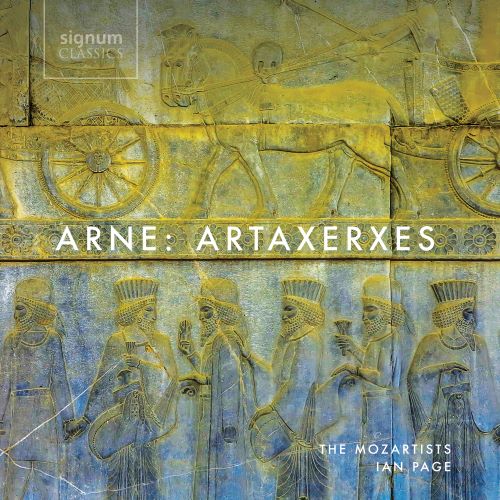
Arne: Artaxerxes
£18.00
Reissue on Signum Records.
The life of Thomas Arne was inextricably linked with Covent Garden. He was born just off the famous piazza, on King Street, on 12 March 1710, and died, a week before his sixty-eighth birthday, in Bow Street. Nowadays a street named in the composer’s honour is situated within a minute’s walk of the Royal Opera House, just off Long Acre.
Arne’s greatest opera, Artaxerxes, was premièred at the Theatre Royal, the predecessor of the Royal Opera House, on 2 February 1762, and remained in the Covent Garden repertory until the late 1830s, receiving a documented one hundred and eleven performances before 1790. The young Mozart almost certainly attended a performance when he came to London in the mid-1760s, and Haydn was also accquainted with the work, enthusiastically exclaiming that he “had no idea we had such an opera in the English language”.
The main reason for the work’s subsequent neglect is a good one: the manuscript and all the original performance materials were burnt in the disastrous fire which destroyed the Theatre Royal in 1808. The opera’s overture, arias and duets had already been published, and so survive intact, as does the libretto, but none of the recitatives or the finale were printed, and they are therefore lost. This recording of Artaxerxes was made following a new production of the opera at the Royal Opera House, Covent Garden in November 2009. To create a complete performing edition of the work for this production I wrote new recitatives, and commissioned the musicologist, composer and baroque violinist Duncan Druce to create a new finale in the style of Arne. These are included in this recording.
The composer
Arne’s father, an upholsterer and coffin-maker, originally intended him for a career in the legal profession. With this in mind he had sent him to Eton College, but his son’s determination to become a musician was unwavering (as a child he had smuggled a spinet into his bedroom and dampened the strings with a handkerchief, so that he could practice at night while the rest of the family slept), and his father eventually consented to his son’s choice of profession. Arne is best known today as the composer of “Rule, Britannia”, which was originally written as part of the masque Alfred, but his output was immense. His settings of Comus (1738), Alfred (1740) and The Judgement of Paris (1742) established him as the leading English theatre composer of his day, and he also enjoyed great success with the songs he wrote for Shakespeare’s The Tempest, As You Like It and Twelfth Night. Soon, though, his productivity and popularity began to wane, and he was not to have another major success for nearly twenty years. Then, just as suddenly, he had three triumphs in as many years, with Thomas and Sally (1760), Artaxerxes and Love in a Village (both 1762). His greatest critical acclaim was reserved for his 1761 oratorio Judith, but this never achieved the success of Artaxerxes, whose fusion of ‘opera seria’ in the Italian style sung in English proved hugely popular with singers and audiences alike.
The libretto
The bedrock of Italian ‘opera seria’ throughout the middle of the eighteenth century was the prolific series of opera texts by Pietro Metastasio (1698-1782). Over eight hundred operas from the eighteenth and early nineteenth centuries were settings of Metastasio, and his Artaserse, which was originally written in 1729 and first set by Leonardo Vinci the following year, was subsequently set by over ninety composers, including Gluck (Milan, 1741) and J. C. Bach (Turin, 1760) – in both cases, incidentally, the composer’s very first opera – in locations ranging from Padua to Stockholm. Arne was probably already familiar with Hasse’s setting, which had been performed in London in 1754.
The English translation of the libretto for Artaxerxes was published anonymously, but is known to have been the work of Arne himself. Charles Burney was rather damning of this aspect of Arne’s work, writing that “the number of his unfortunate pieces for the stage was prodigious; yet none of them were condemned or neglected for want of merit in the music, but words, of which the doctor was too frequently guilty of being the author.” In the preface to the printed libretto, the author attempts to deflect criticism by asserting that it is his “first attempt of the kind”, but in truth the text is not without its merits, and generally serves the music effectively.
The first performance
Artaxerxes received its first performance on 2 February 1762, with a cast led by Charlotte Brent as Mandane and Ferdinando Tenducci as Arbaces. Charlotte Brent (1735-1802) had received a rapturous reception at her début as Polly in The Beggar’s Opera in 1759. She was not only Arne’s long-standing pupil but also, since 1755, his mistress, so it is not surprising that she was given much of the opera’s most virtuosic writing. The great castrato Tenducci (c.1735-90) had come to London in 1758, and was to stay in Britain for almost thirty years. Unusually for a castrato, he married, but his bride’s family was so furious that they promptly kidnapped her and had her illustrious bridegroom thrown into prison. According to Charles Burney, Tenducci’s performance in Artaxerxes “had a rapid effect upon the public taste, and stimulated to imitation all that were possessed of good ears and flexible voices”, while in Tobias Smollett’s 1771 novel The Expedition of Humphry Clinker the heroine Lydia Melford describes hearing “the famous Tenducci, a thing from Italy – it looks for all the world like a man, though they say it is not. The voice to be sure is neither man’s nor woman’s but it is more melodious than either; and it warbled so divinely that while I listened I really thought myself in paradise.”
The title role, actually one of the smaller roles in the piece, was taken by another castrato, Nicolò Peretti, while the three remaining roles were taken by English singers, led by John Beard (1717-91) in the role of Artabanes. Earlier in his career Beard had worked extensively with Handel, creating roles in ten of his operas and the vast majority of his English oratorios, and by 1762 he had also become the manager of the Covent Garden theatre; it was his decision to discontinue the practice of allowing half-price entry for the third act that provoked riots during a performance of Artaxerxes, which wrecked the auditorium and caused damage worth £2,000. The cast was completed by a Miss Thomas in the role of Semira and George Mattocks as Rimenes.
The music
In keeping with the Italian style on which the opera was founded, Artaxerxes is very much aria-dominated, with twenty-six of the twenty-eight numbers being solo arias. There are also, however, significant divergences from the Italianate model, most notably in the relative brevity and formal variety of the arias, almost all of which eschew the ‘da capo’ form so beloved of Handel and his contemporaries. Indeed, it is important to note that Artaxerxes dates from the same year as Gluck’s Orfeo ed Euridice – that is to say, three years after Handel’s death (although twenty years since his last Italian opera) and only five years before Mozart’s first opera – and in keeping with Gluck’s masterpiece Arne’s work is actually more notable for its melodic beauty and emotional directness than for its vocal pyrotechnics.
Artaxerxes is also remarkable for the richness of its scoring. Arne had been the first English composer to include clarinets in his orchestra, and he uses wind instruments with great imagination and variety throughout the opera. One of the most exquisite pieces of scoring, however, is for strings alone. In Arbaces’ “O too lovely, too unkind”, violins are muted and cellos and basses plucked, while divided violas weave a sustained backdrop to the vocal line in a manner that we might now consider to be quintessentially Mozartian. Indeed, this aria is merely the strongest of a number of suggestions throughout the score of Arne’s influence on the young Mozart.
New performing edition
Modern performances of Artaxerxes have been limited by the fact that the work has not survived complete. As was customary, the full score published in 1762 had omitted all the recitatives and the finale, but the complete libretto has survived, so we do know the text of all the missing music, and even which recitatives Arne wrote with orchestral accompaniment.
Nineteenth century revivals following the Covent Garden fire of 1808 used a new version of the opera created in 1813 by Sir Henry Bishop, Covent Garden’s musical director from 1810 to 1824, for which he wrote new, heavily cut recitatives and a finale. These, though, made scarcely any attempt to recreate an eighteenth century idiom, and are stylistically far removed from Arne’s surviving work. This is not that surprising; Bishop would probably not have thought twice about writing in his own contemporary style, living as he did in an age when it was still rare to perform ‘old’ music, and the half century that separates his work from Arne’s original had witnessed not only the complete works of Mozart but also all but one of Beethoven’s symphonies.
For the 2009 Royal Opera production of Artaxerxes and this recording, I composed new recitatives, including the four which Arne set with orchestral accompaniment, which are hopefully comparable to the style of the early 1760s. This was a time-consuming but not especially arduous process, as recitative was a fairly basic and standardised form which evolved little between the death of Handel and the composition of Mozart’s Da Ponte operas. Considerably more skilful is Duncan Druce’s new setting ‘after Arne’ of the finale, complete with the duet passages prescribed in the libretto, which enables this remarkable and beautiful opera to be presented in a fully resolved and complete dramatic form.
© Ian Page, 2021
Act One
Arbaces is in love with Princess Mandane, on account of which he has been banished from Persia by her father, King Xerxes. The two lovers bid a tender farewell, but before Arbaces can leave the palace grounds he is accosted by his father Artabanes, the general of the King’s army, who informs him that he has just assassinated Xerxes. He gives Arbaces his bloody sword to dispose of. Artabanes then convinces Xerxes’ younger son, Artaxerxes, that his elder brother Darius is guilty of the crime, and before his guilt can be disproved Artabanes has Darius executed.
Semira arrives too late with news that Darius is innocent, and that the real assassin has been discovered in possession of the murder weapon. Everyone is astonished when Arbaces is led in under armed guard. He maintains his innocence, but when he refuses to reveal the truth he is presumed guilty.
Act Two
Artabanes urges his son to escape and lead a rebellion, but Arbaces refuses. Instead, Artabanes and Rimenes, a captain in the army, plot to kill Artaxerxes themselves, with Semira offered as Rimenes’ reward. When Arbaces stands trial Artaxerxes, torn by indecision, places his fate in the hands of Artabanes, who condemns his son to death; Artaxerxes, though, permits a stay of execution. Mandane and Semira berate Artabanesand Artaxerxes respectively for their failure to save Arbaces.
Act Three
Artaxerxes comes to Arbaces’ cell and orders him to escape. When Artabanes and Rimenes then arrive and find the cell empty, they assume that Arbaces has already been executed, and resolve to take revenge by poisoning Artaxerxes as he takes his coronation oath. Mandane, meanwhile, is confronted by Arbaces, and struggles to resist her feelings for him.
At his coronation Artaxerxes is about to drink from the poisoned cup, but is interrupted by news that Arbaces has single-handedly quelled a rebellion led by Rimenes. Arbaces enters, and Artaxerxes offers him the cup with which to pledge his innocence. Horrified, Artabanes confesses to his crimes. Artaxerxes spares his life but banishes him from the kingdom, and the two couples – Arbaces and Mandane, Artaxerxes and Semira – are united.
|
CD1
|
|
|
|
ACT ONE
|
||
| 1 | Overture (Poco piu che andante – Larghetto – Gavotta) | 5’13 |
| 2 | Recitative: “Still silence reigns around” (Mandane, Arbaces) | 0’29 |
| 3 | No. 1, Duettino: “Fair Aurora, prithee stay” (Mandane, Arbaces) | 2’16 |
| 4 | Recitative: “Alas, thou know’st that for my love to thee” (Arbaces, Mandane) | 1’13 |
| 5 | No. 2, Air: “Adieu, thou lovely youth” (Mandane) | 3’21 |
| 6 | Recitative: “O cruel parting! How can I survive?” (Arbaces, Artabanes) | 0’57 |
| 7 | No. 3, Air: “Amid a thousand racking woes” (Arbaces) | 4’28 |
| 8 | Recitative: “Be firm, my heart” (Artabanes, Artaxerxes) | 1’26 |
| 9 | No. 4, Air: “Behold, on Lethe’s dismal strand” (Artabanes) | 3’36 |
| 10 | Recitative: “Stay, Artaxerxes, stay” (Semira, Artaxerxes) | 0’29 |
| 11 | No. 5, Air: “Fair Semira, lovely maid” (Artaxerxes) | 3’26 |
| 12 | Recitative: “I fear some dread disaster” (Semira, Rimenes) | 1’29 |
| 13 | No. 6, Air: “When real joy we miss” (Rimenes) | 1’59 |
| 14 | Recitative: “Ye Gods, protectors of the Persian Empire” (Semira) | 0’36 |
| 15 | No. 7, Air: “How hard is the fate” (Semira) | 4’01 |
| 16 | Recitative: “Whither do I fly?” (Tutti) | 3’23 |
| 17 | No. 8, Air: “Thy father! Away, I renounce the soft claim” (Artabanes) | 1’23 |
| 18 | Recitative: “Ye cruel Gods, what crime have I committed” (Arbaces) | 0’14 |
| 19 | No. 9, Air: “Acquit thee of this foul offence” (Semira) | 1’27 |
| 20 | Recitative: “Appearance, I must own, is strong against me” (Arbaces, Artaxerxes, Rimenes, Mandane) | 0’48 |
| 21 | No. 10, Air: “O too lovely, too unkind” (Arbaces) | 4’24 |
| 22 | Accompanied recitative: “Dear and beloved shade” (Mandane) | 0’48 |
| 23 | No. 11, Air: “Fly, soft ideas, fly” (Mandane) | 5’01 |
|
ACT TWO
|
||
| 24 | Recitative: “Guards, speed ye to the tower” (Artaxerxes, Artabanes) | 0’37 |
| 25 | No. 12, Air: “In infancy, our hopes and fears” (Artaxerxes) | 2’12 |
| 26 | Recitative: “So far my great resolve succeeds” (Artabanes, Arbaces) | 1’28 |
| 27 | No. 13, Air: “Disdainful you fly me” (Arbaces) | 2’46 |
| 28 | Recitative: “Why, my dear friend, so pensive” (Rimenes, Artabanes, Semira) | 2’05 |
| 29 | No. 14, Air: “To sigh and complain” (Rimenes) | 1’51 |
| 30 | Recitative: “How many links to dire misfortune’s chain” (Semira, Mandane) | 1’12 |
| 31 | No. 15, Air: “If o’er the cruel tyrant love” (Mandane) | 3’00 |
|
CD2
|
|
|
| 1 | Recitative: “Which fatal evil shall I first oppose?” (Semira) | 0’31 |
| 2 | No. 16, Air: “If the river’s swelling waves” (Semira) | 2’34 |
| 3 | Recitative: “Ye solid pillars of the Persian Empire” (Tutti) | 5’00 |
| 4 | No. 17, Air: “By that belov’d embrace” (Arbaces) | 3’31 |
| 5 | Recitative: “Ah me, at poor Arbaces’ parting” (Mandane, Artabanes) | 0’46 |
| 6 | No. 18, Air: “Monster, away” (Mandane) | 2’36 |
| 7 | Recitative: “See, lov’d Semira” (Artaxerxes, Semira, Artabanes) | 1’02 |
| 8 | Accompanied recitative: “At last my soul has room” (Artabanes) | 0’37 |
| 9 | No. 19, Air: “Thou, like the glorious sun” (Artabanes) | 4’58 |
|
ACT THREE
|
||
| 10 | No. 20, Air: “Why is death for ever late” (Arbaces) | 2’57 |
| 11 | Recitative: “Arbaces! Gracious Heav’n” (Artaxerxes, Arbaces) | 1’13 |
| 12 | No. 21, Air: “Water parted from the sea” (Arbaces) | 2’19 |
| 13 | Recitative: “That face, secure in conscious innocence” (Artaxerxes) | 0’25 |
| 14 | No. 22, Air: “Though oft a cloud with envious shade” (Artaxerxes) | 3’38 |
| 15 | Recitative: “My son, Arbaces… where art thou retir’d?” (Artabanes, Rimenes) | 1’52 |
| 16 | No. 23, Air: “O let the danger of a son” (Rimenes) | 2’15 |
| 17 | Accompanied recitative: “Ye adverse Gods!” (Artabanes) | 0’41 |
| 18 | No. 24, Air: “O, much lov’d son, if death” (Artabanes) | 5’15 |
| 19 | Recitative: “Perhaps the King releas’d Arbaces” (Mandane, Semira) | 1’34 |
| 20 | No. 25, Air: “Let not rage, thy bosom firing” (Mandane) | 4’24 |
| 21 | Recitative: “What have I done? Alas, I vainly thought” (Semira) | 0’24 |
| 22 | No. 26, Air: “’Tis not true that in our grief” (Semira) | 4’08 |
| 23 | Recitative: “Nor here my searching eyes” (Arbaces, Mandane) | 1’20 |
| 24 | No. 27, Duetto: “For thee I live, my dearest” (Arbaces, Mandane) | 3’37 |
| 25 | Recitative: “To you, my people, much belov’d” (Artaxerxes, Artabanes, Semira, Mandane) | 2’20 |
| 26 | No. 28, Air: “The soldier, tir’d of war’s alarms” (Mandane) | 3’33 |
| 27 | Recitative: “Behold, my King, Arbaces at thy feet” (Arbaces, Artaxerxes, Mandane, Artabanes) | 2’25 |
| 28 | No. 29, Finale: “Live to us, to Empire live” (Semira, Mandane, Arbaces, Artaxerxes, Artabanes) | 3’36 |
| Artaxerxes | Christopher Ainslie (countertenor) |
| Mandane | Elizabeth Watts (soprano) |
| Arbaces | Caitlin Hulcup (mezzo-soprano) |
| Artabanes | Andrew Staples (tenor) |
| Semira | Rebecca Bottone (soprano) |
| Rimenes | Daniel Norman (tenor) |
| The Mozartists | |
| Ian Page (conductor) |