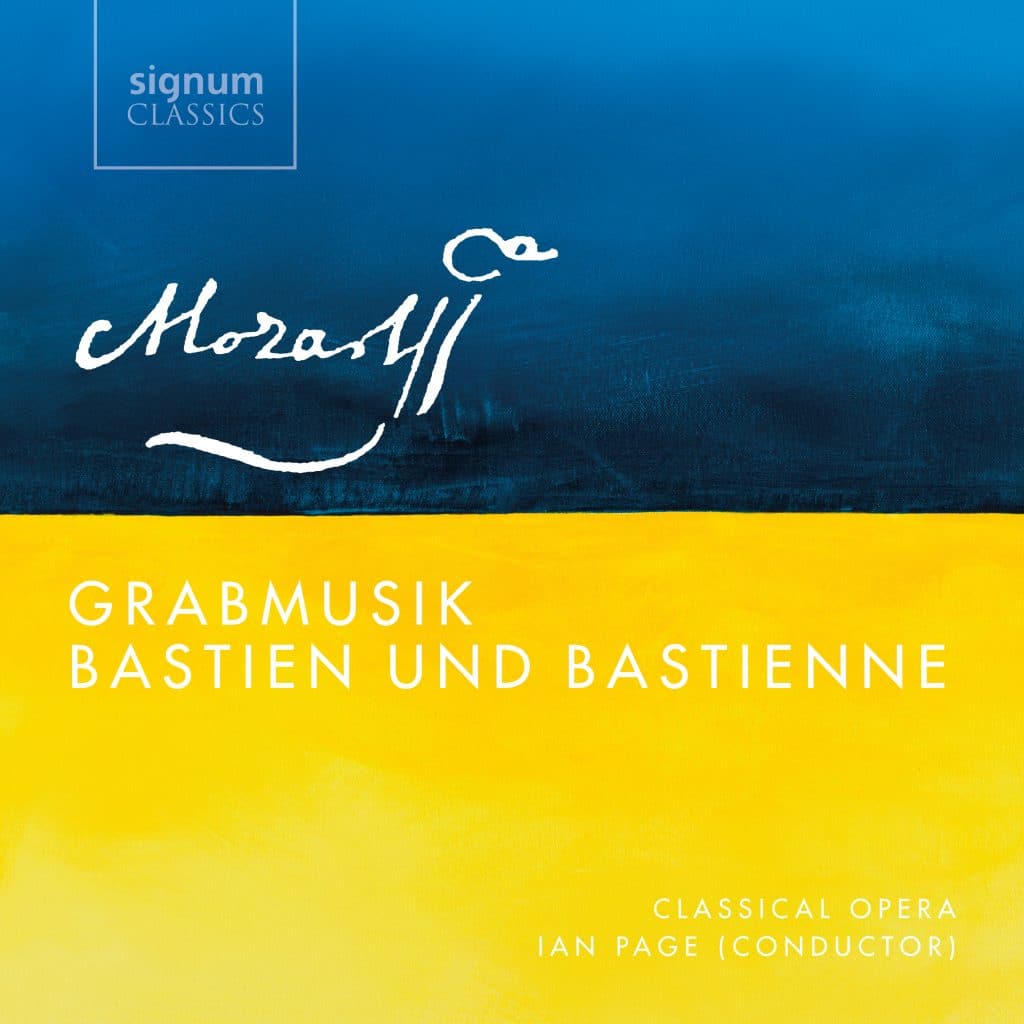
Grabmusik / Bastien und Bastienne
£12.00
PRESTO CLASSICAL: Editor’s Choice
SPOTIFY: Classical Picks Playlist
THE OBSERVER: Critic’s Choice
THE SUNDAY TIMES: Critic’s Choice
2018 INTERNATIONAL CLASSICAL MUSIC AWARDS: Shortlisted
CLIC de CLASSIQUENEWS
GRAMOPHONE
GRABMUSIK
On 9 June 1763, the seven-year-old Mozart and his family set off from their home in Salzburg and embarked on a Grand Tour that was to last for three and a half years. The impact of this formative trip, which included six months in Paris, fifteen months in London and shorter stays in many of northern Europe’s other leading musical centres, can scarcely be over-estimated, and by the time he arrived home on 29 November 1766, less than two months before his eleventh birthday, Mozart already had a remarkable portfolio of compositions to his name. It must have been hard for local musicians and dignitaries to fathom the full extent of the young boy’s fame and success, and in a report that he submitted to London’s Royal Society in 1769 Mr Daines Barrington, an English lawyer who had met Mozart in London and subjected him to an extensive series of musical tests, reported the following anecdote:
“The prince of Saltzbourg, not crediting that such masterly compositions were really those of a child, shut him up for a week, during which he was not permitted to see any one, and was left only with music paper, and the words of an oratorio.
“During this short time he composed a very capital oratorio, which was most highly approved of upon being performed.”
Musicologists believe that the short cantata Grabmusik was the result of this challenge, and although there is no definitive documentary proof for this assumption, it is undoubtedly one of the most remarkable works of Mozart’s prodigious childhood.
The performance during Holy Week of a scenic oratorio before an image or relief of the tomb of Christ is a convention of medieval origin that survives in parts of southern Germany to this day. Grabmusik, which can be translated as ‘Cantata on Christ’s Grave’ (literally ‘Grave Music’), is thought to have been first performed in Salzburg Cathedral during Holy Week 1767. The anonymous text takes the form of a dialogue between a tormented soul, who is desperately lamenting the tragedy of Christ’s death, and an angel. When the work was revived in the mid-1770s, Mozart added a final recitative and chorus, but this recording preserves the original’s taut intensity by ending with the conciliatory duet between the Soul and the Angel.
The Soul’s opening aria is a piece of staggering turbulence and force, and Mozart probably never wrote anything more challenging and virtuosic for the bass voice. Repeated staccato high F sharps, cascading triplets and jagged octave leaps combine to evoke a frenzied exhortation to Nature to break itself asunder in the wake of Christ’s death, and the orchestra already makes a pivotal contribution to the dramatic soundscape; the short middle section even manages to heighten the tension still further, shifting from D major to D minor and diving headlong into harmonies of startling adventurousness.
This visceral outburst is answered astutely and sympathetically by the Angel, firstly in a short recitative and then in a tender G minor aria full of compassion and warmth. Particularly effective, and affecting, is the way the music suddenly breaks off mid-phrase before melting into the final adagio, in which the Angel urges the Soul to calm his fury and dissolve into penitence.
This is followed by a second recitative for the Soul, this time accompanied by the full string section to suggest the slow dawning of comfort and hope in his mind, and this in turn leads into the redemptive final duet, in which the Soul is gradually drawn into the Angel’s consoling, healing and ultimately uplifting power. With this remarkable yet curiously little-known work, the young Mozart already shows himself to be capable of transforming a drily didactic religious text into a work of considerable emotional and dramatic scope, and if this was indeed the piece composed in response to Archbishop Schrattenbach’s test, it was surely a test that Mozart passed with flying colours.
BASTIEN UND BASTIENNE
Bastien und Bastienne is the only one of Mozart’s operas to have been written for performance in a private house rather than a theatre. It was commissioned at some point in mid-1768 by the renowned and controversial German physician Franz Anton Mesmer, and Mozart composed the work in Vienna soon after completing his ill-fated comic opera La finta semplice. No details of its première have survived, and scholarship was further hampered by the loss of Mozart’s autograph manuscript until it miraculously resurfaced in Krakow in the 1980s. We are greatly indebted to the musicologist Linda L. Tyler for her work in clarifying the unusually complex genesis of this slight but charming work.
Provenance
The story of the work’s origins begins in Paris before Mozart had even been born. Parisian musical circles in the early 1750s were dominated by a hard-fought intellectual debate between the relative merits of French tragic opera and Italian comic opera. A performance in Paris of Pergolesi’s intermezzo La serva padrona on 1 August 1752 had sparked the eruption of this debate into what became known as ‘La Querelle des Bouffons’ (‘the squabble of the comedians’; ‘Les Bouffons’ was the name by which the troupe performing Pergolesi’s opera became known), and for the next two years there was a furious exchange of letters, articles and pamphlets on the subject. As with so many such trends and movements, however, the seeds of the quarrel had already been gestating for some time.
One of the leading figures in the debate was the Swiss philosopher and sometime musician Jean-Jacques Rousseau (1712 – 78). Born in Geneva and largely self-educated, he had come to Paris in 1742. Here, while he was developing his philosophical writings, he also attempted to establish himself as a composer, and he even submitted to the Académie des Sciences a proposal for simplifying musical notation by substituting notes with ciphers. This proposal was rejected, most vehemently by Rameau, but it did reflect Rousseau’s firmly-held belief that music should be simple and dominated by melody (though to be fair to his opponents, Rousseau’s musical education and talent barely allowed for anything more complex).
In the spring of 1752, just a few months before the infamous performance of Pergolesi’s La serva padrona, Rousseau penned his only enduring composition, Le devin du village. This unpretentious ‘intermède’ was inspired by the comic operas that he had heard in Venice during a brief posting as secretary to the French ambassador there, and it marked a deliberate attempt to recreate the unadorned charm and simplicity of Italian comic opera in the French language. Numbers were linked by sung recitative rather than spoken dialogue, and the libretto – also by Rousseau – was a generic tale of two young shepherds, Colin and Colette, being reconciled in love by an unnamed Soothsayer (the ‘devin’ of the title) after Colin has briefly been lured away by the attractions of the nearby Lady of the Manor. The work was premièred at Fontainebleau on 18 October 1752, and was an immediate success. It was presented in Paris the following spring, and was to retain its place on the French stage for the next sixty years.
Libretto
The path from Rousseau’s Le devin du village to Mozart’s Bastien und Bastienne is a long and complicated one. The instant popularity of Rousseau’s piece in Paris soon prompted a parody (then as now a sure sign of a work’s success), Les amours de Bastien et Bastienne, by Marie-Justine-Benoite Favart and Harny de Guerville. This version, which was premièred at the Comédie Italienne on 26 September 1753, retained Rousseau’s plot but hardly any of his original text, with Rousseau’s classical French being replaced by more robust and colloquial language. More significantly, Rousseau’s alternation of recitative and air was replaced by an unvaried succession of poetic stanzas that were sung to pre-existing popular vaudeville tunes (this was consistent with established traditions of Italian commedia dell’arte and Parisian comedy troupes), with the result that Rousseau’s recitatives and fourteen numbers became in Favart and de Guerville’s version a continuous sequence of forty-six airs. Dramaturgically, however, the parody improved on the original by extending the argument of the young lovers (now called Bastien and Bastiene) and telescoping the dénouement (five of Rousseau’s fourteen numbers take place after the lovers’ reconciliation) into a single number. It also incorporated some topical populist touches, such as the Soothsayer (now called Colas) first arriving with bagpipes and later delivering a ‘magical’ incantation with gibberish text; both of these new elements subsequently found their way into Mozart’s opera.
Les amours de Bastien et Bastiene proved no less popular than the work which inspired it, and it eventually found its way to Vienna, where it was performed at the Laxenburg Palace and the Burgtheater in the 1750s. In 1764 Giacomo Durazzo, the director of the city’s popular Kärntnertortheater, commissioned one of his leading comic writers and actors, Friedrich Wilhelm Weiskern, to create a German translation of the work (two years later Charles Burney’s English adaptation, The Cunning-Man, was to prove very popular in London), and Weiskern was assisted in his endeavours by one of his colleagues at the theatre, J. H. F. Müller, who wrote the text for Nos. 11 and 12 and the first two stanzas of No. 13. The second ‘n’ in ‘Bastienne’ seems to have been incorporated before the work arrived in Vienna, and Weiskern’s new version was entitled Bastien und Bastienne (actually just Bastienne on the title page, but Bastien und Bastienne at the head of each subsequent page of the libretto).
Weiskern’s German translation remained loyal to Favart and de Guerville’s text, but he did modify its form into the standard structure and style of a Viennese musical comedy, turning most of the French stanzas into spoken German dialogue (in prose) and selecting fourteen numbers to adapt more freely into German verse. Coincidentally, this was the same amount of set-piece numbers as in Rousseau’s original libretto. For nine of Weiskern’s fourteen numbers he retained the exact metre and syllable count of Favart and de Guerville’s text, so that his German lines could be sung to the same prescribed French vaudeville tunes, but for the other five (Nos. 1, 7, 10, 12 and 13) he changed the verse structure to such an extent that new music was required. This task was undertaken by Johann Baptist Savio, music director of the Prague-based troupe of Johann Joseph von Brunnian. Savio’s music has not survived, but the Weiskern-Savio version of Bastien und Bastienne was in the repertoire of a travelling children’s troupe which visited Salzburg in 1766 or 1767, so Mozart might even have been familiar with this work by the time he departed for Vienna on 11 September 1767.
Mozart’s composition
The motivation for the Mozart family’s visit to Vienna was the imminent wedding of The Archduchess Maria Josepha – sister of Emperor Joseph II – to King Ferdinand I of Naples (he was also Ferdinand III of Sicily), and by the time the Mozarts arrived the festivities were already in full swing. Within a few weeks, however, the Archduchess had succumbed to the smallpox epidemic that was sweeping through the city, and suddenly the whole rationale for the Mozarts’ trip unravelled. The planned festivities were cancelled, the theatres closed and the visiting aristocracy departed, and as the epidemic spread the Mozarts removed themselves firstly to Brünn (now Brno) and then to Olmütz (Olomouc). The children were nevertheless unable to avoid the disease, and Wolfgang came close to dying, but thanks to the intercession of a Salzburg acquaintance who was now dean of the cathedral and rector of the university in Olmütz, they were treated in comfort and recovered before the end of the year, returning to Vienna on 10 January 1768. Nine days later they were granted a two-hour audience with the Empress Maria Theresia and Emperor Joseph II.
It was seemingly at the behest of the Emperor that Mozart composed a full-length opera buffa, La finta semplice, over the next five months, but in the event the musical establishment closed ranks to prevent the work’s production. Mozart’s infuriated father petitioned the Emperor, and they remained in Vienna for several more months in the increasingly forlorn hope of having the opera performed, but to no avail. It was presumably at some point during the course of this wait that Mozart was commissioned to write a short opera for private performance in the house of Doctor Franz Anton Mesmer.
Born near Lake Constance in 1734, Mesmer had studied theology, philosophy and law in Vienna before turning to medicine. He achieved widespread notoriety – and notable early success – with his use of magnets to disrupt what he considered to be gravitational tides adversely affecting his patients, but the orthodox medical fraternity found his theories and methods increasingly controversial, and he was eventually accused of fraud and forced to leave Vienna. Mesmer was a keen cellist and harpsichordist, and also played the glass harmonica to patients to induce them into a trance-like state. He was famously satirised by Mozart and Lorenzo da Ponte in the Act One finale of Così fan tutte.
In January 1768 Mesmer married the wealthy widow Maria Anna von Bosch, and in so doing became a well-known figure in Viennese society. The Mesmers were soon entertaining lavishly at their splendid house in the Landstrasse suburb of Vienna, and it was here that Mozart’s Bastien und Bastienne was performed (one of Mozart’s early biographers claimed that the performance took place in the Mesmers’ garden theatre, but this had not been built by 1768).
Salzburg revision
The final part of Bastien und Bastienne’s early history is also the one that has caused the most confusion. After the Mozarts’ return to Salzburg early in 1769, their friend Johannes Schachtner – a court trumpeter and writer who was later to create the libretto for Mozart’s Zaide – took it upon himself to revise Weiskern and Müller’s text, believing their language to be too harsh and unpoetic. This revision involved a few small changes to the sung text that Mozart had already set, but because the music had already been written Schachtner had to fit the exact syllable counts and stresses of Mozart’s pre-existing music. Far more significant, however, was Schachtner’s decision to rewrite all of Weiskern’s spoken dialogue, replacing it with verse which could then be set to recitative and sung; Mozart did indeed set the first four of these, but understandably seems to have run out of enthusiasm.
The repercussions of Schachtner’s revision, however, in conjunction with the loss of Mozart’s autograph manuscript, led musicologists to various false assumptions. Firstly the Vienna commission and première seemed to contradict the known involvement of Schachtner, who had remained in Salzburg throughout 1768, and it was therefore surmised that Mozart had already started work on the opera in 1767 before he left for Vienna. Secondly, all of Schachtner’s changes were incorporated into the accepted version of the work, with the ridiculous result that it began with sung recitative between each number and continued with spoken dialogue.
It was only with the rediscovery of Mozart’s manuscript in the 1980s that the truth was established. Now scholars were able to prove that Mozart used Viennese paper which would almost certainly not have been available to him in Salzburg, and even a perfunctory examination of the manuscript shows that Mozart originally set Weiskern and Müller’s text verbatim – in the handful of places where Schachtner subsequently made changes to the sung text there are clear crossings out on the manuscript, with Schachtner’s words added above or beneath them. As far as we know, this recording is the first performance of Mozart’s original setting of Bastien und Bastienne since its première at Dr Mesmer’s house 250 years ago.
The music
The twelve-year-old Mozart was already a master at matching his compositions to the scale and ambition of the commission, and his music for Bastien und Bastienne perfectly matches the rustic simplicity of the libretto. Over half of the arias last for less than two minutes, but they unerringly capture the dramatic and emotional situation. Note, for example, the speed and efficiency with which Mozart establishes each character within their first aria – Bastienne’s forlorn melancholy (No. 1), Colas’ blustery swagger tinged with genuine compassion (No. 4), and Bastien’s exuberant complacency that all will be well now that he has decided to return to Bastienne (No. 8).
The emotional temperature rises with the soulful tenderness of Bastien’s “Meiner Liebsten schönen Wangen” (No. 11), in which Mozart employs flutes for the only time in the piece, and with the splendidly combative duet (No. 13) in which the two lovers pugnaciously exchange musical stanzas. If Bastien’s despair in the brief accompanied recitative (No. 14) reminds us of Papageno’s near suicide, we should remember that Die Zauberflöte itself belongs to the same tradition of German singspiel, and that many of these moments were stock set-pieces of the genre. Finally, the consecutive ensembles with which the work ends (Nos. 15-16) negotiate a potentially clumsy and sudden resolution with consummate skill and subtlety.
Perhaps the most popular number in Bastien und Bastienne is Colas’ pseudo-magical spell to nonsense words, which is one of few numbers in the opera whose derivation can be traced directly back to Le devin du village. Rousseau’s French gibberish begins “Manche, Planche,/Salme, Palme”, which became “Tätzel, Brätzel,/Schober, Kober” in Weiskern’s German adaptation. This is the only number, however, for which Schachtner’s Salzburg revision provides entirely new words – “Diggi, daggi,/Schurry, murry” – and it has been suggested that this text might have been the work of Mozart himself. Certainly it would have appealed to Mozart’s sense of humour, and we have included “Diggi, daggi” as an appendix on this recording.
Notes & translations © Ian Page, 2018
The shepherdess Bastienne has been abandoned by her sweetheart, the shepherd Bastien, who has been lured away by the attractions a noble lady from the city. She wretchedly laments her plight and seeks the advice of Colas, who has established a reputation as a fortune-teller and magician. Colas reassures her that Bastien still loves her and will soon return, but recommends that when he does so she should feign indifference.
Bastienne departs to tend to her flock, and Bastien now arrives. He joyfully tells Colas that he has seen the error of his ways and is looking forward to being reunited with Bastienne. Colas congratulates him on his decision, but warns him that he is too late and that Bastienne now has another admirer. Bastien, distraught, urges Colas to consult his Book of Magic. Colas casts a terrifying hocus-pocus spell, after which he predicts that Bastien will be able to win Bastienne back if he works hard to take better care of her.
Bastien is left alone, and when Bastienne returns she rebuffs him, saying that he cannot be her Bastien, for he was faithful and loving. Bastien tries to persuade her that Colas has banished the malevolent forces that were overpowering his judgement, but they continue to argue until Bastien declares himself ready to commit suicide. Bastienne wishes him good luck.
Eventually, however, they acknowledge that their love for each other remains undimmed, and Colas returns to celebrate the happy outcome.
|
GRABMUSIK, K.42/35a (original 1767 version)
|
||
| 1 | No. 1, Recitative: “Wo bin ich? bittrer Schmerz!” (Die Seele) | 1’02 |
| 2 | No. 2, Aria: “Felsen, spaltet euren Rachen” (Die Seele) | 6’02 |
| 3 | No. 3, Recitative: “Geliebte Seel’, was redest du?” (Der Engel) | 1’04 |
| 4 | No. 4, Aria: “Betracht dies Herz und frage mich” (Der Engel) | 4’06 |
| 5 | No. 5, Accompanied recitative: “O Himmel! was ein traurig Licht” (Die Seele) | 1’16 |
| 6 | No. 6, Duet: “Jesu, was hab’ ich getan?” (Der Engel, Die Seele) | 4’44 |
| BASTIEN UND BASTIENNE, K.50 (original 1768 version) | ||
| 7 | Intrada | 1’40 |
| SCENE ONE | ||
| 8 | No. 1, Aria: “Mein liebster Freund hat mich verlassen” (Bastienne) | 1’56 |
| 9 | Dialogue: “Du fliehst von mir, Bastien?” (Bastienne) | 0’45 |
| 10 | No. 2, Aria: “Ich geh jetzt auf die Weide” (Bastienne) | 1’34 |
| SCENE TWO | ||
| 11 | No. 3: Entrance of Colas | 0’18 |
| 12 | No.4, Aria: “Befraget mich ein zartes Kind” (Colas) | 1’04 |
| 13 | Dialogue: “Guten Morgen, Herr Colas!” (Bastienne, Colas) | 1’59 |
| 14 | No. 5, Aria: “Wenn mein Bastien im Scherze” (Bastienne) | 2’36 |
| 15 | Dialogue: “O, die Edelfrau vom Schloß” (Colas) | 0’18 |
| 16 | No.6, Aria: “Würd ich auch, wie manche Buhlerinnen” (Bastienne) | 1’17 |
| 17 | Dialogue: “Gib dich zufrieden!” (Colas, Bastienne) | 1’01 |
| 18 | No.7, Duet: “Auf den Rat, den ich gegeben” (Colas, Bastienne) | 1’33 |
| SCENE THREE | ||
| 19 | Dialogue: “Dieses Liebhaberpaar ist wahrlich ein rechtes Wunderwerk” (Colas) | 0’41 |
| SCENE FOUR | ||
| 20 | No.8, Aria: “Großen Dank dir abzustatten” (Bastien) | 1’25 |
| 21 | Dialogue: “Es freut mich, daß du endlich zu dir” (Colas, Bastien) | 0’41 |
| 22 | No.9, Aria: “Geh! du sagst mir eine Fabel” (Bastien) | 1’17 |
| 23 | Dialogue: “Das kann sein” (Colas, Bastien) | 1’18 |
| 24 | No. 10, Aria: “Tätzel, Brätzel, Schober, Kober” (Colas) | 1’20 |
| 25 | Dialogue: “Ist die Hexerei zu Ende?” (Bastien, Colas) | 0’21 |
| SCENE FIVE | ||
| 26 | No. 11, Aria: “Meiner Liebsten schöne Wangen” (Bastien) | 3’02 |
| SCENE SIX | ||
| 27 |
Dialogue: “Da ist sie” (Bastien, Bastienne)
|
1’03 |
| 28 | No. 12, Aria: “Er war mir sonst treu und ergeben” (Bastienne) | 2’26 |
| 29 | Dialogue: “O, ich sehe schon, was dich verdrießt” (Bastien, Bastienne) | 0’59 |
| 30 | No. 13, Aria: “Geh hin!” (Bastien, Bastienne) | 5’53 |
| 31 | Dialogue: “Siehe da! bist du noch hier?” (Bastienne, Bastien) | 0’33 |
| 32 | No. 14, Accompanied recitative: “Dein Trotz vermehrt sich durch mein Leiden?” (Bastien, Bastienne) | 0’50 |
| 33 | Dialogue: “Und sollte ich wohl ein solcher Narr sein” (Bastien, Bastienne) | 0’25 |
| 34 | No. 15, Duet: “Geh! geh! geh, Herz von Flandern!” (Bastienne, Bastien) | 5’18 |
| SCENE SEVEN | ||
| 35 | No. 16, Trio: “Kinder! Kinder! seht, nach Sturm und Regen” (Colas, Bastienne, Bastien) | 3’06 |
| APPENDIX | ||
| 36 | No. 10, Aria (2nd version, 1769): “Diggi, daggi, schurry, murry” (Colas) | 1’30 |
| Bastienne/Der Engel | Anna Lucia Richter (soprano) |
| Bastien | Alessandro Fisher (tenor) |
| Colas | Darren Jeffrey (bass-baritone) |
| Die Seele | Jacques Imbrailo (baritone) |
| The Mozartists | |
| Ian Page (conductor) |