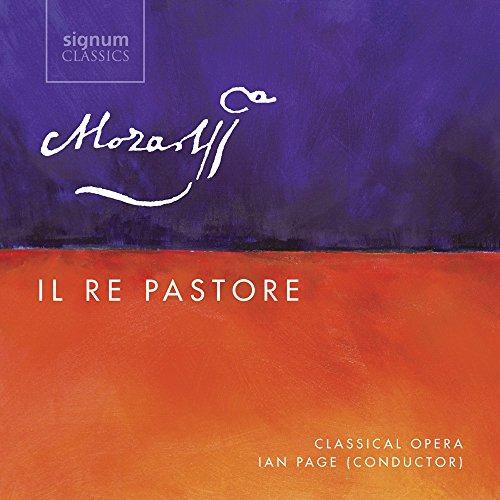
Mozart: Il re pastore
£18.00
GRAMOPHONE: Editor’s Choice
ATTRIB. ALEXANDER THE GREAT
Mozart’s Il re pastore was commissioned by the Archbishop of Salzburg to celebrate the royal visit of Archduke Maximilian Franz. It was premièred on 23 April 1775. The choice of Metastasio’s popular libretto, in which Alexander the Great searches for the rightful heir and places him on the throne of Sidon, was a particularly apt one, for the ceiling of the Knights’ Hall in the Archbishop’s Palace – the room in which Mozart’s opera was first performed – features a series of paintings by the Austrian artist Johann Michael Rottmayr, all dating from 1714, which also depict scenes from the life of Alexander. It might also have appealed to the composer’s subversive sense of humour that the acts of heroism evoked on the ceiling were not entirely mirrored by Metastasio’s often ironic portrayal of Alexander’s bungling attempts at match-making as he seeks to bring peace and political harmony to the kingdom of Sidon.
Background
On 16 December 1771 Mozart’s employer, Sigismund von Schrattenbach, had died, and was succeeded by Hieronymus, Count Colloredo, who was installed as the new Prince-Archbishop of Salzburg on 29 April 1772. Schrattenbach had been very supportive of the young Mozart, and had recognised his importance and usefulness as an ambassador for Salzburg. It was for this reason that Mozart’s father Leopold had been given extended paid leave of absence to show off his prodigiously gifted children at the most prestigious courts in Europe – indeed, Mozart, who was only fifteen years old when the Archbishop died, had spent a mere thirty months in Salzburg during the previous ten years.
Archbishop Colloredo’s attitude, however, was quite different – Mozart and his father were his employees (Wolfgang was promoted to the position of Konzertmeister in August 1772), and as such they were required to carry out their respective duties as court musicians. Mozart was begrudgingly allowed to go on his third and final visit to Italy to fulfil the commission of Lucio Silla for Milan, and he also wrote La finta giardiniera for Munich at the end of 1774 – it would have been politically embarrassing to deny him this opportunity, for the Archbishop himself had been invited to attend the Carnival festivities at which the new opera was to be performed. For most of the 1770s, though, Mozart was trapped in an increasingly frustrating and servile role in the home town which he steadily grew to loathe and resent. He was paid an annual salary of 150 florins for his duties as a practising, performing musician, but received little additional reward for his compositions. Nonetheless, he composed prolifically during these first years back in Salzburg – symphonies, serenades, concertos, masses and numerous chamber works – and several of his earliest masterpieces date from this period. But opera was Mozart’s greatest passion, and his primary frustration was that Salzburg had no theatre. As long as he remained there, he would not be able to concentrate his energies on writing operas.
The commission and first performance
Mozart was, however, required to write one opera during these years in Salzburg. Archduke Maximilian Franz, the youngest son of the Habsburg Empress Maria Theresia, was visiting Salzburg in April 1775 on his way to Italy, and Archbishop Colloredo commissioned two works to honour his visit: Salzburg’s senior court composer Domenico Fischietti was to set Metastasio’s text Gli orti esperidi for the opening celebrations, while Mozart was to set the same librettist’s Il re pastore for performance the following evening. Both works were referred to as serenatas, signifying not only that they were composed for a special occasion but also that they were reduced in length from the standard three-act ‘opera seria’ and that they were performed with either very limited staging or none at all. Both were written for a cast of five – one soprano castrato, two sopranos and two tenors – and two leading artists from the Munich Court Opera were engaged for the occasion. The castrato Tommaso Consoli had sung the role of Ramiro in the first performances of Mozart’s La finta giardiniera three months earlier, and he had already portrayed the role of Elisa in Munich the previous year in a setting of Il re pastore by Pietro Alessandro Guglielmi; for Mozart’s setting, rather more sensibly, Consoli was to perform the male role of Aminta. The other visiting artist from Munich was the flautist Johann Baptist Becke, whose presence was perhaps more necessary for Fischietti’s work, for Mozart’s opera includes only one number with virtuosic flute parts.
No confirmation has survived of the other cast members, but given that they were all members of the Salzburg court ensemble it seems likely that the soprano roles of Elisa and Tamiri would have been played by Maria Magdalena Lipp and either Maria Anna Fesemayr or Maria Anna Braunhofer. In the spring of 1767 all three of these singers had sung in the first performance of Die Schuldigkeit des ersten Gebots, which also took place in the Knights’ Hall of the Archbishop’s Palace. Each of the three parts of this sacred singspiel had been written by a different composer contracted to the Salzburg court – the first part by the eleven-year-old Mozart and the remaining two by Michael Haydn (brother of the more famous Joseph) and Anton Adlgasser – and shortly afterwards Lipp and Fesemayr had married Haydn and Adlgasser respectively. Franz Anton Spitzeder, who was a court tenor in Salzburg from 1760 until 1796 and who had sung the role of Christgeist in Die Schuldigkeit des ersten Gebots, probably sang one of the tenor roles (presumably that of Alessandro), with the other one possibly being taken by Felix Hofstätter, about whom little more is known.
Archduke Maximilian arrived in Salzburg on 22 April 1775, and Fischietti’s Gli orti esperidi was performed that evening; Il re pastore received its first performance the following evening. The Knights’ Hall is a surprisingly small room, and any staging must have been extremely basic. No records survive about whether the singers wore costumes, or even whether they sang from memory or not, but the fact that Consoli (who was taking the leading role in both works) and Becke had only arrived in Salzburg on 19 April gives us a fair indication of how little rehearsal time was considered necessary.
The libretto
Metastasio’s original text for Il re pastore had been written in 1751 to celebrate the birthday of the Empress Maria Theresia, and it was first performed in the theatre of Schönbrunn Palace with the five roles all taken by Maria Theresia’s children – the part of Alexander the Great was originally played by the future Emperor Joseph II, who was aged fourteen at the time, but Maximilian Franz, who was the same age as Mozart, had not yet been born (nor had his sister, the future Marie Antoinette). As court poet in Vienna, Metastasio had already been required to write plays for these birthday celebrations for the previous twenty years or so, and the parameters were clearly defined: not only must the plays glorify monarchy and imbue the performers with enlightened aesthetic values, but in addition no villains or evil actions were allowed to be portrayed, as this would reflect discredit on the royal children who were acting out the roles. It is presumably for this reason that the tyrant Strato has already been deposed before the action of Il re pastore begins, and Tamiri, though understandably predisposed to dislike and distrust Alexander, never actually aligns herself in any way to her father’s views or methods.
The music for the original 1751 performance was written by the Viennese court composer Giuseppe Bonno, with whom Mozart was to come into contact many years later, and by 1775 the text had already been set by a further thirteen composers, including Hasse, Gluck, Jommelli and Piccinni. When Mozart had been in London as a nine-year-old he had probably attended a setting of the opera by Felice de Giardini which was being performed at the King’s Theatre, Haymarket. The story of the shepherd king, innately good but brought up in humble ignorance of his true identity, had always been a popular one, of course, harking back to the biblical story of King David, and it provided an enduring role model for enlightened leadership.
Mozart’s setting of Il re pastore was based on the two-act reduction of Metastasio’s libretto which had been used for the 1774 Munich revision of Guglielmi’s setting, the one that had featured Consoli as Elisa. This version essentially retained Metastasio’s Act One and then reduced and merged Acts Two and Three into a single whole which lasted no longer than Act One. Mozart did make a few small changes to the 1774 Munich libretto, including the reinsertion of a few lines that had been cut from Metastasio’s original. There are also three places where he set completely new text in place of Metastasio’s; it has been assumed that these new sections of text were penned by the Salzburg court chaplain, Giovanni Battista Varesco, but there is no firm evidence of this.
Two of the changes were clearly made to heighten the dramatic peak at the end of each act. In Act One new text is added before the final duet, and this text is set as accompanied recitative, thereby giving greater import to the ensuing duet. Metastasio’s finales, meanwhile, were habitually brief and perfunctory, prompting music settings which often lasted scarcely longer than a minute, and it was presumably felt that something more extended, festive and celebratory was required, especially in the context of Archduke Maximilian’s state visit. The only other significant change was for Aminta’s second aria, where Metastasio’s “So che pastor son io” is entirely replaced by “Aer tranquillo”. Mozart maybe felt that he had already established the pastoral mood in Aminta’s short opening aria, with its bucolic flute accompaniment, and required something more vivacious, virtuosic and contrasting for the shepherd’s second aria, which follows shortly afterwards.
Mozart clearly held “Aer tranquillo” in high regard, for he referenced its infectiously energetic opening bars just a few months later as the main theme of the first movement of the G major violin concerto, K.216. He also programmed the aria in several concerts he gave, and at some point he composed an alternative solo recitative to precede it, again with entirely new and unidentified text. It is in two parts – the first accompanied by continuo only, the second by full strings – but in dramatic and plot terms it does not replace or even enhance Metastasio’s original text. There has been some confusion as to where this recitative belongs, and previous recordings of Il re pastore have included it within the main body of the opera, but it seems clear that it was conceived by Mozart for subsequent occasions when the aria was performed in isolation as a concert piece. For this recording, the alternative recitative has therefore been placed as an appendix at the end of Act One, so that listeners have the opportunity to hear this ‘concert version’ of the aria as a separate entity.
Mozart’s final text of Il re pastore, combined with the music he composed for it, is much more fluid and dramatic than the rather portentous stereotype of opera seria, and although Metastasio should take some of the credit for this we can already recognise Mozart’s genius for capturing real and truthful human emotions. On the title page of his last opera, La clemenza di Tito – another setting of Metastasio – Mozart changed the poet’s nomenclature of opera seria (‘serious’ or ‘grave opera’) to opera vera (‘true opera’). Had Il re pastore been able to receive a full staging in Salzburg, he might well have made the same distinction sixteen years earlier.
The music
By 1775 Mozart had already composed such celebrated works as the Exsultate, Jubilate and the symphonies no. 25 (in G minor, K.183) and no. 29 (in A major, K.201), so it should come as no surprise that the music for Il re pastore is of a consistently high quality. What is particularly noticeable about this score, though, is the way in which it evokes its own specific (though of course definitively Mozartian) sound world. In the rhythmic energy and drive of the overture it is not hard to imagine Alexander the Great’s army laying siege to foreign lands, but as soon as we encounter the shepherd Aminta we immediately enter a calmer and less belligerent world. The music throughout is quintessentially ‘outdoor’ in feeling, though often not in a traditionally pastoral manner, and there is always a sense that these are real people expressing real feelings. Perhaps the most remarkable achievement of the first act is that each aria is an expression of joy, contentment or devotion, and yet Mozart still manages to create enormous variety and contrast within this framework.
Alexander’s first aria contains extraordinary evocations of storms and rainfall, and the string writing in all his arias incorporates hints, however brief, of falling rain. Aminta’s music, too, is often suggestive of water, but in his case the lapping semiquavers of second violins are more suggestive of running streams and rustic tranquillity. This subtle water imagery, which Mozart was to develop in Idomeneo to evoke powerful images of the sea, serves to underline the contrasts as well as the similarities between Alexander and Aminta, whose music at the same time shares with Elisa’s first aria a wonderful ‘fresh air’ quality.
The climate gradually changes in the second act, as the repercussions of Alexander’s misconceived plan to marry Tamiri to Aminta take root, and the music is now able to have a much wider emotional range, from Elisa’s opening pain at being separated from Aminta to the shepherd’s own poignant expression of love, “L’amerò, sarò costante”, the most exquisite and celebrated number in the piece, scored for violin solo, flutes, cors anglais, bassoons, horns and muted strings. Agenore, having had to control his feelings while each character in turn sings an aria to (or in some cases at) him, finally gives vent to his anguish in an aria that is quintessential ‘Sturm und Drang’, but by the final quintet, which contains some miraculous moments reminiscent of the very greatest of Mozart’s works, the irrepressible high spirits and vivacity of the first act are restored.
Notes © Ian Page, 2015
The opera is set in Sidon, Phoenicia, in 332 BC. Alexander the Great has just conquered the city, overthrowing the tyrannical usurper Strato. Before moving on to further conquests he determines to find Abdolonimo, the rightful heir to the throne, who has been brought up in humble obscurity, unaware of his true identity.
Act One
A wide pleasant landscape in the hills outside Sidon
Elisa excitedly tells her beloved Aminta that her mother finally supports their union, and she rushes off to see her father. Alexander interrogates Aminta and, impressed by his candour and nobility, is convinced that this shepherd really is Abdolonimo, the rightful heir to the throne. Agenore recognises his beloved Tamiri, Strato’s daughter, who is now in hiding and disguised as a shepherdess, following Alexander’s victory over her father. Agenore is unable to persuade Tamiri to reveal herself to Alexander, but vows to come back to her soon. To Tamiri’s great joy and relief, he reassures her that he still loves her.
Elisa now returns to tell Aminta that her father has consented to their marriage, but before they can leave, Agenore arrives to proclaim that Aminta is the rightful king. Aminta and Elisa are astounded, and waver uncertainly between excitement and fear.
Act Two
Alexander’s camp
Elisa is looking for Aminta, but Agenore prevents them from seeing each other. Alexander regrets not being able to forgive Tamiri publicly, and worries about the damage this will do to his reputation. When Agenore mentions that he knows where Tamiri is hiding, Alexander, blithely unaware of anyone’s amorous attachments, decides that it would be a political masterstroke for Aminta to marry Tamiri; duty and honour prevent the horrified Agenore from protesting.
A large cave
Aminta is still unresolved as to whether to accept the throne, but when Agenore arrives he ambiguously declares that he has finally decided to fulfil his duty. For Aminta, this duty involves renouncing the throne and remaining true to Elisa, but Agenore assumes that Aminta has decided to become king and to take Tamiri’s hand. He urges Aminta to take good care of his new bride, and Aminta, thinking he is referring to Elisa, assures him that he will always remain loving and devoted to her. Elisa is devastated when she hears that Aminta is to marry Tamiri, while Tamiri is appalled that Agenore could so readily give her up to someone else.
The outer courtyard of the Temple of Hercules in Sidon
As Alexander asks the gods to look favourably on his plans, Tamiri tells him of Agenore’s sacrifice and of their love. Elisa likewise opens her heart to Alexander, imploring him to help. Aminta then arrives in his shepherd’s clothes, renouncing his royal position in favour of his flock and marriage to Elisa. Alexander, moved by such courage and honesty, appoints Aminta and Elisa to the throne of Sidon, and promises Tamiri and Agenore another kingdom to rule. All ends happily.
| CD1 | ||
| 1 | Overtura | 2’53 |
| ATTO PRIMO | ||
| Scena I | ||
| 2 | No. 1, Aria: ‘Intendo, amico rio” (Aminta) | 2’06 |
| 3 | Recitativo: “Bella Elisa, idol mio” (Aminta, Elisa) | 3’25 |
| 4 | Recitativo: “Alla selva, al prato, al fonte” (Elisa) | 5’30 |
| Scena II | ||
| 5 | Recitativo: “Perdono, amici Dei” (Aminta, Agenore, Alessandro) | 3’09 |
| 6 | No.3, Aria: “Aer tranquillo e dì sereni” (Aminta) | 6’13 |
| Scena III | ||
| 7 | Recitativo: “Or che dici, Alessandro?” (Agenore, Alessandro) | 1’08 |
| 8 | No. 4, Aria: “Si spande al sole in faccia” (Alessandro) | 4’37 |
| Scena IV | ||
| 9 | Recitativo: “Agenore? T’arresta” (Tamiri, Agenore) | 2’10 |
| 10 | No. 5, Aria: “Per me rispondete” (Agenore) | 3’35 |
| Scena V | ||
| 11 | Recitativo: “No, voi non siete, o Dei” (Tamiri) | 0’34 |
| 12 | No. 6, Aria: “Di tante sue procelle” (Tamiri) | 4’16 |
| Scena VI | ||
| 13 | Recitativo: “Oh lieto giorno! oh me felice” (Elisa, Aminta) | 1’11 |
| Scena VII | ||
| 14 | Recitativo: “Dal più fedel vassallo” (Agenore, Elisa, Aminta) | 2’09 |
| Scena VIII | ||
| 15 | Recitativo: “Elisa! Aminta! È sogno?” (Aminta, Elisa) | 0’31 |
| 16 | Recitativo accompagnato: “Che? m’affretti a lasciarti?” (Aminta, Elisa) | 3’02 |
| 17 | No. 7, Duetto: “Vanne a regnar, ben mio” (Elisa, Aminta) | 6’03 |
| APPENDIX | ||
| Concert version of No. 3, Aria | ||
| 18 | Concert version of No. 3, Recitativo: “Compagne amene” (Aminta) | 1’14 |
| 19 | Concert version of No. 3, Recitativo accompagnato: “Ditelo voi pastori” (Aminta) | 2’11 |
| 20 | Concert version of No. 3, Aria: “Aer tranquillo e dì sereni” (Aminta) | 6’20 |
| CD2 | ||
| ATTO SECONDO | ||
| Scena I | ||
| 1 | Recitativo: “Questa del campo greco” (Elisa, Agenore) | 2’13 |
| 2 | No. 8, Aria: “Barbaro, oh Dio! mi vedi” (Elisa) | 4’56 |
| Scena II | ||
| 3 | Recitativo: “Nel gran cor d’Alessandro” (Agenore, Aminta) | 2’28 |
| Scena III | ||
| 4 | Recitativo: “Per qual ragione resta il re” (Alessandro, Aminta) | 1’57 |
| Scena IV | ||
| 5 | Recitativo: “Or per la mia Tamiri” (Agenore, Alessandro) | 3’24 |
| 6 | No. 9, Aria: “Se vincendo vi rendo felici”(Alessandro) | 6’04 |
| Scena V | ||
| 7 | Recitativo: “Oimè! declina il sol” (Aminta) | 0’47 |
| Scene VI | ||
| 8 | Recitativo: “E irresoluto ancora” (Agenore, Aminta) | 1’08 |
| 9 | No.10, Rondeaux: “L’amerò, sarò costante” (Aminta) | 7’03 |
| Scena VII | ||
| 10 | Recitativo: “Uscite, alfine uscite” (Agenore) | 0’13 |
| Scena VIII | ||
| 11 | Recitativo: “Ma senti, Agenore” (Elisa, Agenore) | 1’36 |
| Scena IX | ||
| 12 | Recitativo: “Povera ninfa! io ti compiango” (Agenore, Tamiri) | 1’15 |
| 13 | No.11, Aria: “Se tu di me fai dono” (Tamiri) | 4’32 |
| Scena X | ||
| 14 | Recitativo: “Misero cor!” (Agenore) | 0’22 |
| 15 | No.12, Aria: “Sol può dir come si trova” (Agenore) | 2’50 |
| Scena XI | ||
| 16 | No.13, Aria: “Voi, che fausti ognor donate” (Alessandro) | 3’54 |
| 17 | Recitativo: “Olà! che più si tarda?” (Alessandro, Tamiri, Agenore) | 0’37 |
| Scena XII | ||
| 18 | Recitativo: “Ah giustizia, signor” (Elisa, Alessandro) | 1’03 |
| Scena XIII | ||
| 19 | Recitativo: “Signore, io sono Aminta” (Aminta, Alessandro, Agenore, Elisa, Tamiri) | 1’49 |
| 20 | No.14, Coro: “Viva l’invitto duce” (Elisa, Tamiri, Aminta, Agenore, Alessandro) | 6’13 |
| Alessandro, Alexander the Great, King of Macedonia | John Mark Ainsley (tenor) |
| Aminta, a shepherd, in love with Elisa | Sarah Fox (soprano) |
| Elisa, a noble Phoenician girl, in love with Aminta | Ailish Tynan (soprano) |
| Tamiri, a daughter of the tyrant Strato, in love with Agenore | Anna Devin (soprano) |
| Agenore, a nobleman of Sidon, in love with Tamiri | Benjamin Hulett (tenor) |
| The Mozartists | |
| Ian Page (conductor) |